Showing posts with label Events: Japan. Show all posts

Saturday, November 01, 2008 - 11:07 pm

Hyottoko and Okame

This one is related to a post two weeks ago. (No Entry, October 28 2008)

Okay, after coming all the way to Yokosuka, my plan was ruined because I was refused entry into the Navy Base. Sure enough I left before they changed their mind and decided to give me an anal probe security check.

But luckily, I managed to take some cool shots during the procession earlier. Now, that made my trip worthwhile. I've posted these photos on both my Flickr Photostream and my photoblog. I know it's redundant, but I'll just post two of them here together with the short descriptions which can be found on the other two sites.

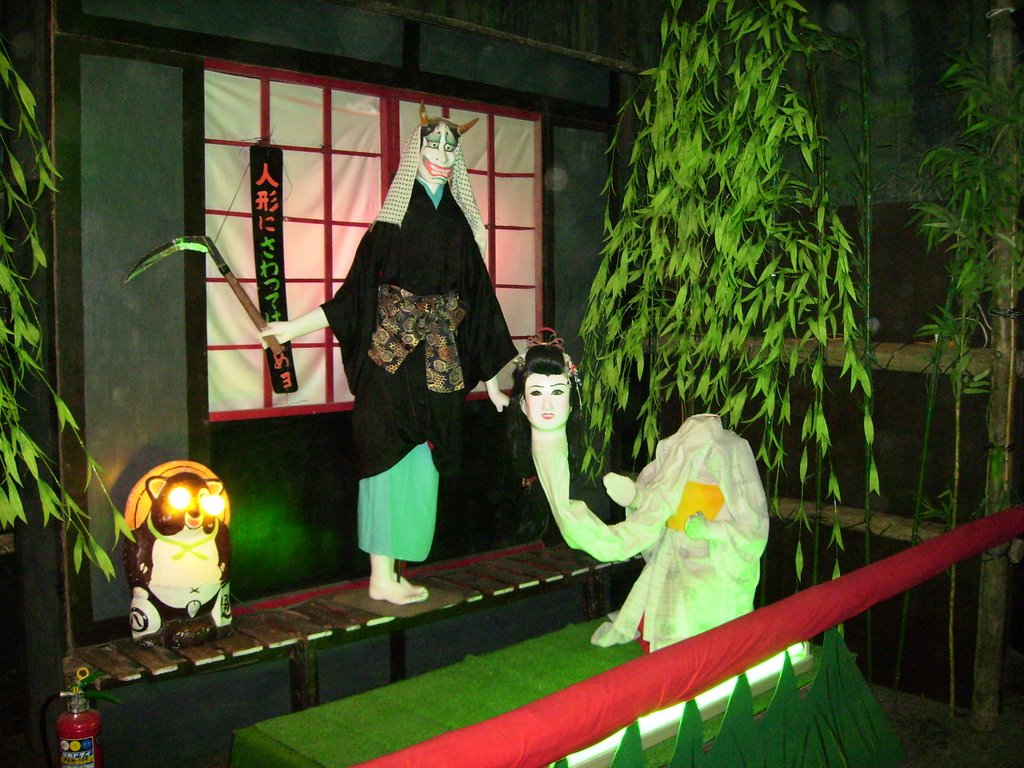
Kagura Masks: Hyottoko ひょっとこ

Kagura (神楽 - God Entertainment) masks are used in Shinto theatrical dance. They can often be seen in matsuri (Japanese festivals). This one here is a boy character called hyottoko. (Those who have watched the Japanese movies, Death Note and L: Change the World, can probably recall the mask used by L to conceal his identity.)

There're several versions to its origin. One has it that it comes from hi-otoko (火男 - fire boy), who blows out the flame in the kitchen stove with a bamboo stick (thus the shape of his mouth).

The other version comes from a local myth in Ishikawa prefecture. It is said that there was once a boy with an odd face who produces gold in his navel. Ever since his death, it is believed that by placing a mask resembling his face at the kitchen stove, the family will be blessed with prosperity. Somehow, the name of the boy hyoutokosu (ヒョウトコス) transformed into hyottoko.

The girl character, okame complements this one.

Oh, and that's not a salut. it's just the awkward mechanical way he walks (imagine tin man with stiff joints marching in a parade and you'll get a rough idea).

Kagura Masks: Okame おかめ

This one here is a girl character called okame or otafuku.

The squished round nose, the high cheeks and the moon face are the main characteristics of this character. She complements the boy character, hyottoko.

Sometimes, though, it is also used to represent a boy character.

Wednesday, May 16, 2007 - 10:01 am

The Essence of Edo: Kanda Matsuri

It's Kanda Matsuri (神田祭) from yesterday till 15 May.

Oh, well then, what's the big deal?

Of course it's a big deal. After all, this has been one of the biggest festivals in Edo (now Tokyo). What's more, it's more worth a look especially in odd years. This year, 2007, for instance. Because the festival had been too extravagant in the olden days, the Tokugawa Shogun decreed that it should only be held at a grand scale during odd years but at a modest scale during even years. Anyway, I missed the main event, which was held on Saturday; didn't know about the festival until I saw the news report in the evening. Well, better than missing the whole event.

The Kanda Matsuri is held at the Kanda Myōjin Shrine (神田明神) in Ochanomizu, which is one station away from Kanda (神田) on the JR Chūō Line (JR 中央線). (Actually, Ochanomizu is also part of Kanda, the city centre of Edo. The shrine is also within walking distance from Akihabara, Japan's biggest town specializing in electrical goods, and also home to Japan's otaku sub-culture.)

As for some background history on Edo...

During the Edo Period when Japan was said to have three capitals, Edo was the capital of the Tokugawa Shogunate (while Kyoto was the residence of the emperor, and Osaka as the unofficial capital). Even till now, there's still dispute over whether Kyoto, or Tokyo is the official capital. For the same reason, Japanese from the Kansai region still hold pride over their Kanto counterpart.

Okay, I digressed. But before the photos, let's have a brief Japanese lesson.

Firstly, we have, 人. This is the kanji, hito, meaning "people". Then, there's this, word ごみ. Gomi, meaning, "rubbish". Combine these two words, and you get 人ごみ. Which means...?

... something like this.

Not "human rubbish" but "crowd".

Hongō Dōri (本郷通り), the main street which led to the shrine, was terribly crowded, as expected. (Any sane person who has better things to do would avoid visiting the place.) All you see is just heads and more heads...

Unless... if you climb up the railing by the sidewalk for a better view. The police were busy manning the "human traffic". They're not going to stop you unless you're trying to get onto the police patrol car. (A guy really did attempt to do that.)

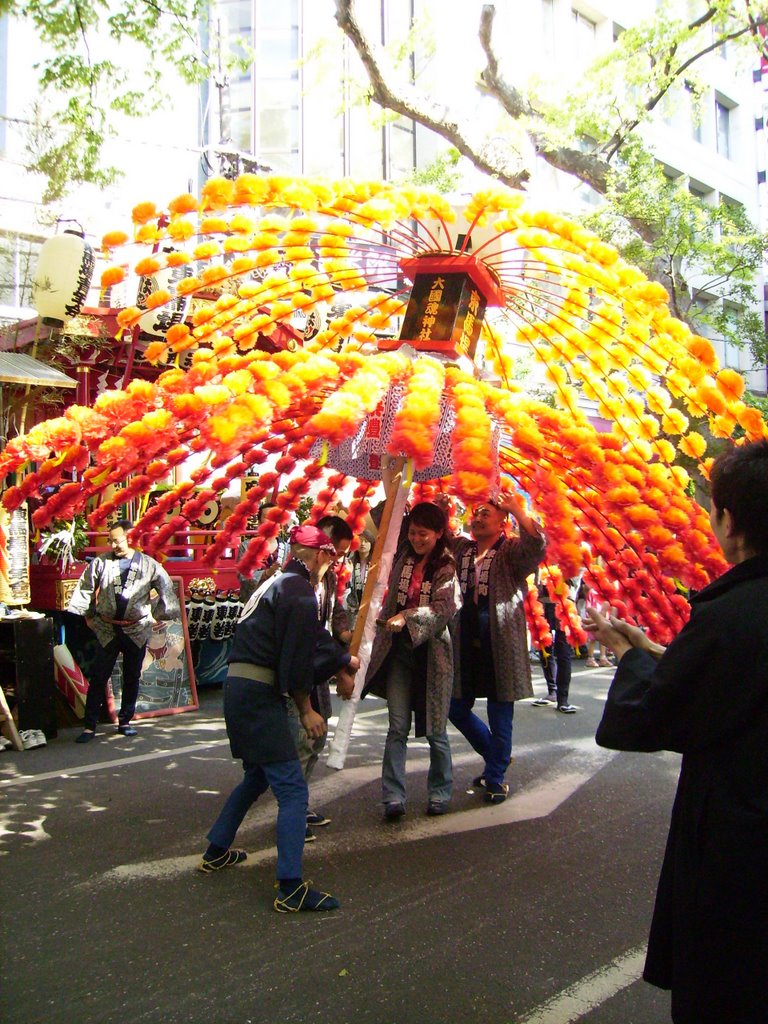
Portable shrines, mikoshi (神輿) were brought to the Kanda Myōjin shrine. Photo taken while standing on the railing, leaning against the lampost, trying my best not to fall head first onto the road, and getting stomped by the mikoshi-bearing guys.

Note the delicate design of the mikoshi. It's normally designed as a miniature version of a shrine and has a golden phoenix "roosting" on the apex.

The festival wasn't much different from the Kurayami Matsuri I went to in Fuchū last year. But unlike the Kurayami Matsuri, there was no Taiko procession in the Kanda Matsuri. Perhaps they had it the day before. One thing special about this festival, though, is the two-wheeled dashi (山車). They used to be common design for dashi during the Edo Period but the floats nowadays have at least three wheels, for easier manouvring. I looked for the two-wheeled floats but unfortunately, couldn't see any.

One thing that I liked the most was the taiko (太鼓) performance. The stacatto beats, the energetic movements of the drummers; in a way, it gives me the same feeling as in watching summer firework displays (花火). (By the way, I hope I won't miss the Sumidagawa fireworks display this summer. 28 of July. Make note, make note...)

My first encounter with real-life geisha's (芸者). They were present for the ceremony.

This cute little soba monster (check out his "soba hair"), was brought into the shrine the day before. As mentioned earlier, the main even was held on Saturday. Looks like I really did miss the grand parade. Sniff, sniff.

Anyway, there's another matsuri coming up this weekend; Sanja matsuri (三社祭). This time it's in Asakusa (浅草) and it is no less grander than the Kanda Matsuri, for it's also another of the three main festivals of the city of Edo. Well, I guess I'll go and have a look if I managed to finish my revision for next week's maths exam!

- May 13, 2007, Sunday -

Thursday, July 27, 2006 - 5:13 pm

Tamagawa Hanabi

Oh man! This is the coolest event you can look forward to in Japan! Fireworks displays (花火, hanabi)!

There is not only one, but as many as ten fireworks displays in Tokyo throughout late July and early August, with the one in Sumida (Asakusa) being the largest Hanabi event. It is an extremely fun experience watching Hanabi but is equally exhausting. You'll need to get to the venue as early as three or four hours before the event starts just to get a spot. Well, unless if you don't mind spending a few thousand yen for a special seat, of course.

Thanks to the guys from TOFSIA, we had a good spot to watch the hanabi by the Tama River (多摩川) in Chofu.

Well, this is how crowded it was... Right from the station to the streets, and from the streets to the riverbank.
The weather didn't seem so good. Nevertheless, everyone was in such a good mood that no one cared so much about a little shower... But it didn't rain, luckily. Until the hanabi ended.

A tripod and a good camera... That's exactly what you need to take shots of the hanabi. And, uh... plenty of memory space... Which was what I didn't have... Just a mere 512 MB. My new camera comes with a "fireworks" option, specially for taking photos during occasions like this. I guess the overseas model don't have this function.

Soon, the summer sky got dark and the hanabi started right on time at 7.20pm.

The fireworks are partly sponsored by the Chofu municipal council, and mostly by companies and other individuals.

Some fireworks were sponsored by parents who wish for their children's health.

Some were even by those who wished to get good results in their university entrance exam.

It is believed that the bigger the firework explosion, the better the luck you'll get.

There were forty over sponsors.

I like this. They look like flowers dancing in the wind.

This one looks like the milky way.

And, oh my god! This was the greatest of all! The grand finale! So, that's what the cranes were for. The fireworks were hung over two cranes, horizontally. When lit, they looked like the Niagara Falls. This one is flowing with golden water, though!
Welcome to El Dorado! Whoa! You won't believe this unless if you see it with your own eyes!

Most people started to leave right after this grand finale. I guess that's what everyone was waiting for. Well, guess what, by the time the hanabi ended, it was 8.30pm. One million fireworks had been let off non-stop for as long as 70 minutes!

- 23 July 2006, Sunday -

Thursday, May 11, 2006 - 6:48 pm

Kurayami Matsuri

Kurayami Matsuri (暗闇祭り, literally, pitch-dark festival) is celebrated at Ōkunitama Jinja (大国魂神社) in Fuchu from 3 May to 5 May. The main event is held on 5 May night but we were brought there by TOFSIA on 4 May, which puzzled me. Anyway, I was in Sendagaya National Stadium on Friday, fulfilling my duty as a patriotic citizen of Malaysia by cheering for the Malaysian team during the Thomas Cup semi-final match against Denmark.

(Above:) Ōkunitama Jinja in Fuchū.

(Above:) Main hall.

(Above:) The place was so crowded that it reminded me of the jam-packed Shinjuku.

(Above:) In the temple's compound, it seemed just like a fun fair.

(Above:) See? They even had a haunted house!

(Above:) A tower in the shrine's compound.

(Above:) A gate that leads to another part of the shrine, closed to the public on that day.

(Above:) For a small fee, you can get your fortune told. And if you don't like what you got? Well, just hang them here and let the wind blow the bad luck away!

(Above:) The following day was Children's Day (子供の日, kodomo no hi). The celebrate the day with carp-shaped koinobori flags.

(Above:) A huge stone which has some significance to the emperor... Geez... Can some one translate the Japanese for me?

(Above:) I managed to get out from the shrine before getting suffocated. But, the situation outside wasn't any better.

(Above:) A taiko (太鼓, Japanese drum) procession was taking place!

(Above:) Standing on the big drums while they were pulled along the streets by the devotees requires good balance!

(Above:) The devotees take turns striking the drum... With a baseball bat? I think not!

(Above:) A portable shinto shrine (神輿, mikoshi). I supposed this is just a scaled-down version.

(Above:) Children carrying a mikoshi on two poles.

(Above:) Sometimes, the devotees wave the mikoshi side by side so widely that participants and bystanders get killed getting struck by it!

(Above:) Now, this should be the big one, parked inside the shrine. The procession would be on Friday, but we missed it because we were in Sendagaya watching Thomas Cup!

(Above:) This used to be a religious event. But now it has turned into a competition to see who can spin it the most gracefully.

(Above:) There were various performances by the road. These people were playing traditional Japanese flute and drums, in a monotonous rhythm...

(Above:) Cute kids, no? I asked the Japanese but they didn't know what's the significance of those characters in the masks.

(Above:) Now, this was the most interesting of all performances. It puzzled me as to why these "monsters" (化け物, bakemono) went around "biting" children. Actually, in Japanese folklore, a person who gets bitten by these "lions" gets good luck!

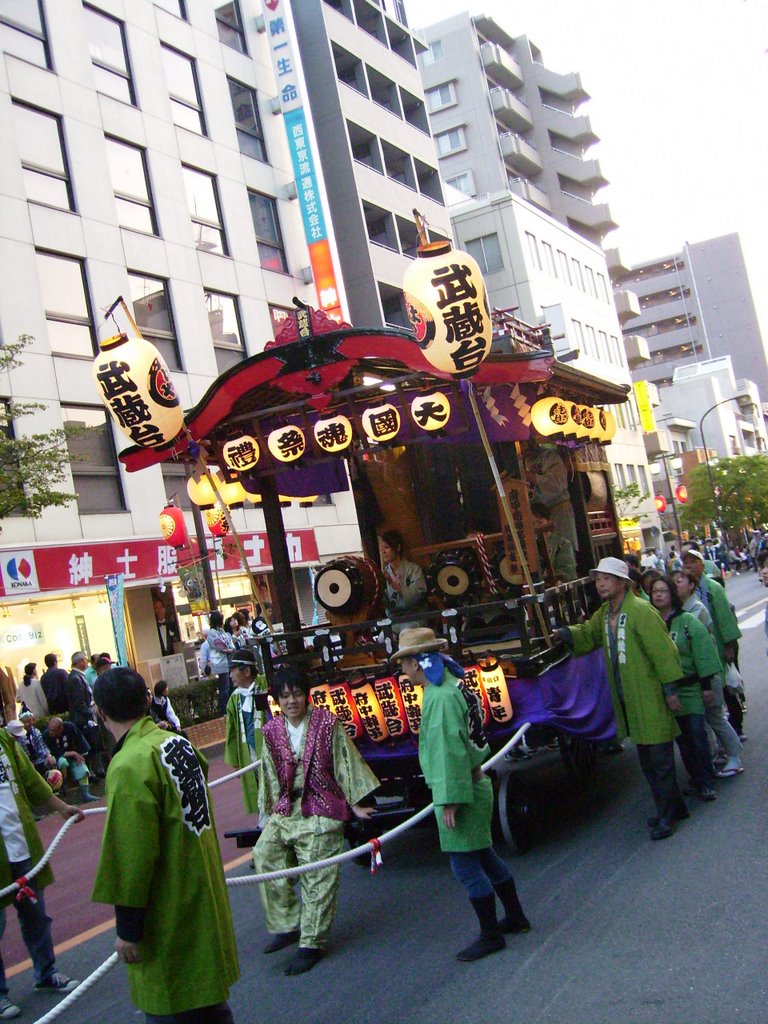
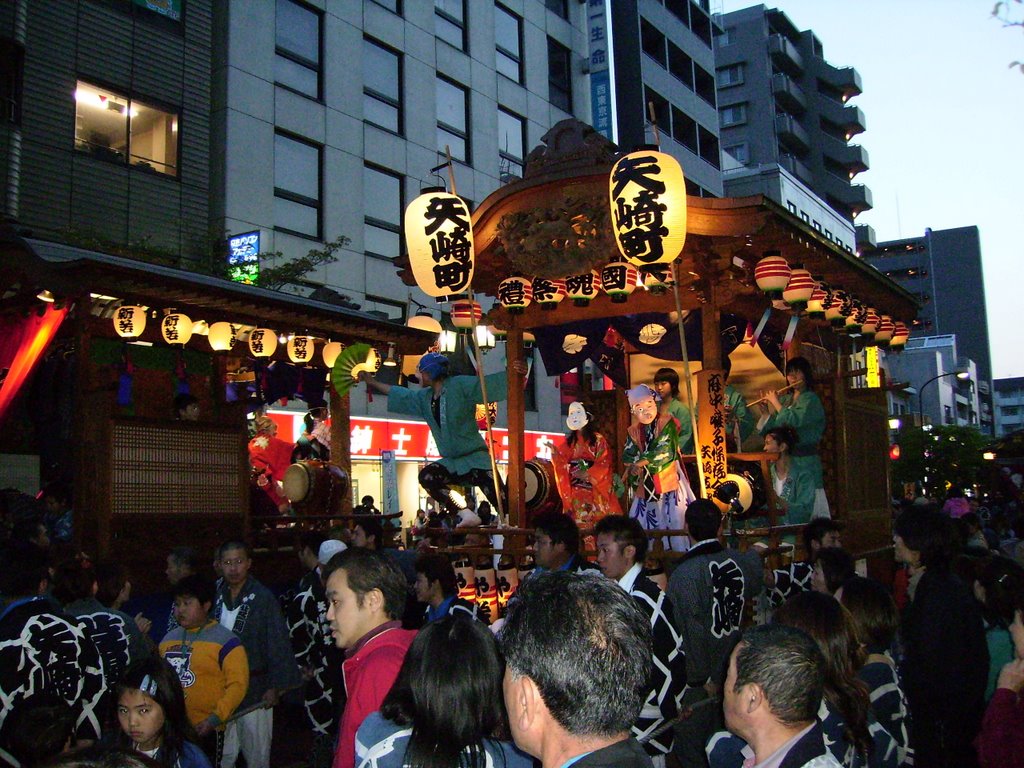
(Above:) At 6pm, there was float procession.

These floats, like the taiko drums were from different shrines across Tokyo.

(Above:) Even though the floats looked so big and heavy, these guys were pulling them effortlessly as if they were going downhill...

(Above:) The procession lasted until late night.

- 04 May 2006, Thursday -

Monday, May 08, 2006 - 4:20 pm

Golden Week

It has been a month since I arrived in Tokyo on April 4. So far, this is my first update on life in Japan. I'm sure you've already noticed that my blog is fast turning into a photo album instead. Well, what to do? Withouth a laptop, going online is so inconvenient. Whenever I'm in the library, I'm busy uploading photos; whenever I feel like babbling away, I don't have the chance to blog. Someone should propose that the library be open for use 24/7. Anyway, now that the holidays are over, the library is open for business as usual.


Last week was the Golden Week, so called because three of the major holidays fall in that week. April 29 is Green Day (緑の日), May 3 is Constitution Memorial Day (憲法の記念日), May 5 is Children's Day (子供の日). As for May 4, which is sandwiched between two holidays, it's declared as an official national holiday as well. For most companies (no, not our university, unfortunately), May 1 and 2 are also off days and voila! you have a whole week of holiday! This is the season when the Japanese come out of their nests and fling money like drinking water. And yes, that was what I did too; burning cash to fuel my new-found passion, sightseeing, that is.

This is a gist of what I've done during the Golden Week.

April 29: Went to a barbeque with TOFSIA at Koremasa (是政). TOFSIA is a group of Japanese students volunteered to help out international students.

April 30: Sightseeing in Takahatafudōson Temple (高幡不動尊金剛寺).

May 1 and 2: Lessons as usual, no holiday! Sigh!

May 3: Visited Ueno Zoological Park and Tokyo National Museum, both in Ueno (上野).

May 4: Went to Ōkunitama Jinja (大国魂神社) in Fuchū (府中) to see Kurayami Matsuri (暗闇祭り) float possession.

May 5: Stopped by at Heisei Jingu in Yoyogi (代々木) before going to Sendagaya (千駄ヶ谷) to cheer for the Malaysian team in the Thomas Cup semi-final match against Denmark. Thanks, Teik Chuan, for getting the subsidised tickets for us from the embassy!

May 6: Had dinner with a senior in Shinjuku (新宿). Thanks for the treat!

May 7: Rainy day. Stayed in the dorm to study. Thanks to my far-sightedness, I checked the weather forecast last week and anticipated the bad weather. So, I arranged to go out on the first four days even though I preferred to study first before enjoying myself.

Now that the Golden Week is over, life is back to the normal hectic pace. We'll be sitting for a mid-term exam on May 25, which is barely three weeks away!


Sorry, can't be lingering any longer! Somebody help me!